Tuesday, July 18, 2017

HS2 AND THE UNION

We can be said live in a one sided Union, it can be argued that either the Union works for all, or it doesn't. If it doesn't then it's not a beneficial Union. It’s certainly clear that it is not a fair and equal Union, it's a Union of unequals, especially where Wales and Welsh interests are concerned.

Most recently Welsh companies have missed out on contracts worth £6.6 billion to build the first phase of England’s high speed rail line, HS2. The contracts, which will support around 16,000 jobs, have been awarded to mainly English, Austrian, Swedish and French firms.

No Welsh firms were shortlisted and no Welsh firms will participate in any consortia. A study by quantity surveyor Michael Byng, released over the weekend, estimates that the cost of building HS2 could reach over £100 billion, making it the most expensive railway in the world.

Public spending on England-only projects usually triggers consequential funding for the devolved nations but as the UK Government has designated HS2 as an “England & Wales” project, despite every inch of the railway being in England.

Wales was designated a HS2 0% rating at the last Comprehensive Spending Review for Barnett Consequentials whilst northern Ireland and Scotland were rated 100%.

A report published by accountancy firm, KPMG, in 2010 showed that HS2 will have an overall negative effect on the Welsh economy, resulting in 21,000 fewer jobs in Wales by 2040 as a result of jobs shifting to the English Midlands and the north of England.

The companies shortlisted for contracts (source:  House of Commons’ Library)
Welsh taxpayers will certainly contribute towards building the most expensive railway in the world, even though not one inch of it being in Wales and the fact that the British Government has deliberately avoided giving Wales its fair share of investment in return by describing the project as an “England and Wales” investment even though it is actually having a negative impact on jobs and wages in Wales. 
  
HS2 may cost £100 billion if reports are accurate, if the project was correctly labeled as an England-only project, then Wales would be entitled to £5 billion. Our share could be used to invest in our own transport infrastructure. What’s going to happen is that our taxes are being used to fund a high-speed line for England.

The Welsh Labour Government should have ensured that Welsh companies were promoted during the procurement process. There can be no excuse for the British Government to direct contracts to overseas countries, supporting jobs and wages elsewhere instead of supporting our own companies here in Wales. It should be clear by now that Westminster is not clearly working for Wales. 

The so-called ‘partnership of equals’ between the four constituent nations is merely a sham. The Union, as is, offers all the risk and little or no reward as the Labour Welsh Government simply sits on its hands. Only Plaid Cymru will stand up and fight for Wales to get its fair share of investment from HS2 and work to make sure that Westminster treats Wales fairly.

Tuesday, July 11, 2017

IMAGINARY TRAINS...

Imaginary trains...
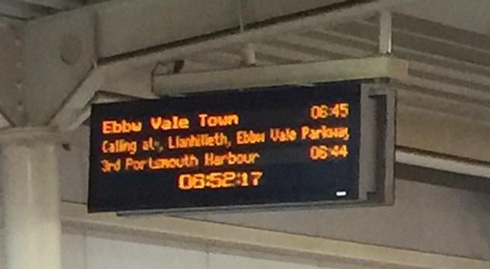
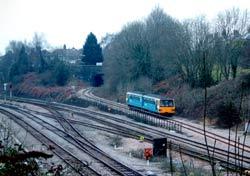
Now and then, if you look very quickly on Newport Station, you can sometimes see the platform indicators flagging up an Ebbw Vale bound train. Blink and you might miss it - this may be the closest many rail passengers will come to seeing a ghost train. Despite regularly oft-repeated promises from the Labour in Wales government in Cardiff and more locally elected Labour in Newport representatives, there is no sign any time soon of a permanent rail connection between Ebbw Vale and Newport.

The Ebbw railway line reopened in 2008 carrying a years worth of anticipated passengers in a few months. From the start the new rail service failed to connect to Newport and the rest of the south east - a variety of lame excuses have been offered which fail to conceal that fact that the Welsh Government has been dragging its feet. Somewhat ironically periodic upgrades to track and signals in and around the Cardiff area meant that services do actually occasionally start and terminate at Newport.

The failure to connect the Ebbw vale line to Newport means that commuters living in the communities in the Ebbw valley are unable to travel directly to Newport by train and have little choice but to use their cars. They are denied the opportunity of catching connecting trains to Bristol, Cheltenham, and beyond as well as travelling slightly more rapidly to Cardiff in the morning and back again in the evening.

This was either simply a bad short-sighted decision that resulted in commuters having no choice but to choose to drive to work or was a deliberate decision. This lack of an easily accessible alternative helps to feed congestion on the M4. If we are lucky at some as yet undetermined future date the Ebbw vale link may actually begin to benefit those commuters who daily travel east to and from work.

Nothing to see here, move along...
What seems to be missing here in Wales is any real element of reopening old (or building new) railways as has happened in Scotland. In Wales in the last 17 years there have been 2 successful railway re-openings carried out by Network Rail at the request of the National Assembly; the Vale of Glamorgan Railway Line (re-opened on Friday 10th June 2005) and the Ebbw Valley Railway Line (partially re-opened on Wednesday 6th February 2008). These were largely administrative rather than legislative projects, and save for the existence of the National Assembly they would have lingered on somewhere on Network Rails’ priority list.

The National Assembly, has been (with a few exceptions) been pretty muted when it comes to making the case for rail. This has certainly not been the case in Scotland, where bills to reopen old railways have been vigorously debated, scrutinised, amended and passed by the Scottish Parliament. If we are serious about integrated public transport then we are going to have to get serious about how we are going to develop and redevelop our under invested public transport infrastructure.


The Transport (Wales) Act, in February 2006, gave the National Assembly the powers but not the political will to plan and co-ordinate an integrated transport system. Future development plans will be complicated, as back in March 2017, the Westminster Conservative government decided, whether by accident, design or as a result of a general indifference to Wales (and Welsh interests) not to devolve control of that portion of Network Rail to the Wales but to retain it in London.

The largely non UK owned rail companies have continued to ramp up rail fares and have quietly attempting to reduce rail services (they have been thwarted in the later endeavour by some well organised local pressure groups in the case of Severn Tunnel and Chepstow in South East Gwent). All of these things have been done with the tacit co-operation of various Westminster and Welsh Governments and the Department for Transport (in London) certainly for 2 out of the 3 of these august bodies our transport issues and our infrastructure will never be a priority.


It would be nice if the government in Cardiff woke from its self induced slumbers and took the long term view, and actually put its money where its mouth is and work to redevelop our rail services, to boost the development of rail freight and to co-ordinate rail and bus services across the whole of Wales. To do this effectively Wales needs to have full control of its transport policy and transport budget devolved as quickly as possible and the Wales franchise should be run on a not for profit basis.


If we could create a not-for-distributable-profit organisation to run our railways; then profits would be available to invest in rail services. This could mean more frequent services in the South Wales valleys, more frequent journeys to West Wales and on the Cambrian line, as well as additional services between the north and south of Wales.

This could also mean more investment in new rolling stock to help keep pace with increasing passenger demand.  This is sadly not going to happen anytime soon, which is a real pity as a delivery model that is better suited to the needs of the people in Wales rather than the foreign state-owned railway shareholders dividend can be developed, would be a sensible and popular decision.  

Locally Abergavenny, Caldicot, Chepstow and Severn Tunnel railway stations should be real local transport hubs, with fully integrated local bus services and better rial services. Better facilities for passengers are needed, as is the provision of adequate safe secure parking facilities, which are urgently required.

Plaid in Monmouthshire has previously called for feasibility studies into the development of a Parkway Station at Little Mill and the possibilities of re-opening the railway line from Little Mill to Usk. The development of a new railway station to the west of the town of Usk would significantly benefit local commuters, rail travellers and also reduce road congestion. 

The re-opening of Pontrilas Railway station (in south Herefordshire) for passenger traffic and timber shipments would also help. As would a realistically scoped feasibility study into developing regional rail freight services, removing heavy Lorries from local roads.


Such developments would provide a regular rail service to local people and reduce the ever-increasing traffic burden from already overcrowded roads. Local priorities should be the completion of the final stage of the rail-link from Ebbw Vale to Newport and railway stations at Caerleon (which has been in the UDP since 1986), and it should not be a case of a station at Llanwern or Magor but both as they would all help to reduce road congestion and bring benefits to local commuters and rail passengers.

Sunday, July 9, 2017

PLAID’S BILL TO RESTORE POLICE FUNDING

Plaid Cymru peer, Dafydd Wigley on Thursday 6th July introduced a Private Members’ Bill in the House of Lords to ensure the police forces are adequately resourced.

Government funding for the Police in Wales and England has been cut by 25% over the past five years.

The former Plaid Cymru leader’s Bill will ensure the Police have the resources they need to carry out their core duties including combatting extremism and ensuring that communities are kept safe.

The UK Government sets the police budget on an annual basis. Lord Wigley’s Bill seeks to reform the way the Police are funded by placing a new duty on Police and Crime Commissioners to submit a funding estimate to the Secretary of State outlining the financial needs of their police force. If there is a discrepancy between the Commissioner’s estimate and the Secretary of State’s budget, it must be referred to an independent body for adjudication. Any continuing divergence between the two figures would need to be justified to Parliament by the Secretary of State.

The Bill follows reports made to Plaid Cymru by retired senior police officers that cuts to Safer Neighbourhood Teams (SNT) have limited the capacity of the Police to gather intelligence on extremism and gang crime.

According to research compiled by crime expert, Harry Fletcher, each SNT would have had six officers including a Sergeant and two Police Constables and covered, on average, one council ward each. Today the average is 3 staff and the area covered is 75 per cent larger.

SNTs collect intelligence on extremist, gang and criminal activity and behaviour. Information gathered on extremism is passed to the Borough Counter Terrorism Liaison Officer who in turn work with UK Counter Terrorism to assess risk and danger.

Lord Wigley’s Bill also places a duty on Police and Crime Commissioners to carry out a full risk assessment in respect of any person subject to investigation for potential extremist behaviour that could encourage, incite or instigate acts of violence. The Secretary of State must, in turn, provide sufficient resources to allow such assessments to take place.

Plaid Cymru advocates devolving policing to Wales, mirroring the situation in Scotland and Northern Ireland, which would trigger a funding boost of around £25 million per year for the Welsh police forces.

Lord Dafydd Wigley said:

“Police forces in Wales and in England have been subjected to sustained cuts to their budgets which have undoubtedly detracted from their capacity to support the work of the security services.

“Government funding for the Police has been cut by 25% over the past five years and vital aspects of policing and public safety are now under-resourced as a result.

“Units such as Safer Neighbourhood Teams, which carry out crucial work in support of counter terrorism efforts, have been cut to the bone. Ten years ago, Safer Neighbourhood Teams, which collect intelligence on extremist, gang and criminal activity, would have had six officers including a Sergeant and two Police Constables and they covered, on average, one council ward each. Now each team has an average of just three members of staff and cover areas that are 75 per cent bigger than before.

“Public safety surely has to be a government’s top priority and yet the UK Government seems willing to put public safety at risk.

“My Bill seeks to ensure that the Police have the resources they need to carry out their duty to keep the public safe. It would ensure that police budgets reflect their needs, allowing vital units such as Safer Neighbourhood Teams to take a greater role in supporting the work of security and intelligence services.

“I hope that my Bill will attract cross-party support today.”

Crime expert and director of Digital Trust, Harry Fletcher, who worked Lord Wigley on the Bill said:

“The fall in the number of police officers has had an impact on the Police’s capacity to gather intelligence. This Bill would ensure that police budgets were the subject of independent scrutiny and bring about greater accountability to the Home Office. Public protection must come first.”

ENDS

Notes to editors:
  
Bill summary

The Bill seeks to place a duty on Police and Crime Commissioners to submit a funding proposal, which the Secretary of State must either agree to, or refer to an independent body. It would require the Secretary of State to justify any divergence between the proposal and the final settlement to the House of Commons.

It will also place a duty on the Treasury to provide additional resources to a police force in the event of a major incident; and place a duty on all organisations, departments or authorities involved in any crime incidents where there are multiple victims to retain and make available to the Police all relevant evidence and documentation.

Supporting statistics

Government funding for the Welsh and English police forces has been cut by 25% over the last five years: https://fullfact.org/crime/police-funding-england-and-wales/

According to crime expert, Harry Fletcher, the cost of surveillance for one week on one person is at least £26,000 which equates to over £1.4 million for a full year.

WalesOnline coverage of figures supporting claim that if policing was devolved, Welsh police forces would be £25 million per hear better off:


Saturday, July 8, 2017

OUR POLICE NUMBERS CUT

Westminster slashes number of police officers

Wales has 753 fewer police officers now than it did in 2010
The number of police officers in Wales has dropped by 753 since 2010 according to figures from the Police Federation.

The figures show the impact of Westminster budget cuts on frontline policing and has prompted renewed calls for responsibility over policing to be passed from Westminster to the National Assembly for Wales.

The Police Federation figures show that Gwent police have been worst hit, losing 22% of its police officers, with South Wales Police and North Wales Police losing 8% and Dyfed-Powys losing 4%. Overall the number of police officers in Wales has dropped by 10% since 2010.

In addition to the drop in number of police officers, the Police Federation data shows that 78% of police officers in Wales and England say that they do not have sufficient numbers of officers to do their job properly and 58% said they don’t have enough time to do their job properly.

Commenting on the figures, Plaid Cymru’s Home Office spokesperson, Liz Saville Roberts said:

“The British Government is putting public safety at risk in the name of their unnecessary obsession with shrinking public services.

“This is the result of sustained cuts to spending – a police force that is under-staffed, under-resourced and under pressure.

“No police force can lose 310 police officers in just five years – as Gwent Police Force has – without it affecting the force’s capacity to perform their duties of keeping the public safe and supporting the security services.

“We know that units such as Safer Neighbourhood Teams, which carry out crucial work in support of counter terrorism efforts, would have had six officers including a Sergeant and two Police Constables ten years ago, and they covered, on average, one council ward each. Now each team has an average of just three members of staff and cover areas that are 75 per cent bigger than before.

“These are the unseen consequences of Westminster austerity and although unseen, the real impact is the public as a whole are less safe.

“The UK Government will say that crime rates are low but this goes beyond crime on the streets – this will impact extremism, radicalisation and gangs. The police are now expected to deal with 21st century crime such as cybersecurity, fraud and online grooming while also keeping police officer on the beat. 

“Plaid Cymru has long advocated transferring responsibility over Welsh policing from Westminster to Wales, allowing us to escape the London-centric one-size-fits-all approach to policing but it is also crucial that we do so to protect police funding.

“We will continue to make the case for the police in both Wales and England to be properly resources but it remains the case that if policing was devolved, the Welsh police forces would be better off by £25 million per year – more than enough to replace those lost officers.

“Westminster has no justification for keeping their hands on Welsh policing and the longer it continues, the deeper the cuts will be and ultimately it is public safety that will pay the price.”

ENDS

Police Officer number statistics taken from a briefing entitled Officer Number Briefing 4.07.17


Friday, July 7, 2017

BRECHT IS STILL BRECHT...

It was once famously declared 'Comment is free, but facts are sacred' (C.P. Snow, the editor of the Manchester Guardian, 1872 - 1929). While this principle is still largely still observed, at least by some of the former Fleet Street titles, it should be clear by now that a combination of so called 'Fake News' (or perhaps more accurately news that feels true), vitriolic opinion (disguised as news) with punchy headlines sells rather well (even if sections of the electorate choose to ignore them).

Managed news...

S
ome people make much of the rise of the so called alt-right which it can be argued can be put down to a combination of a reaction against globalisation, digitalisation, global interconnectivity, nostalgia and desperation. This electorally and emotionally has seen the rise and development over the last 30+ years of what has more recently been described as post truth politics.

Now this is something not confined solely to this island archipelago, the USA and other parts of europe, it is a truly global phenomenon, and one that appears to be here to stay. It is, however, not a relatively recent development, post truth politics has been alive and kicking since at least the late 1960's (if not before) with effective emotional political narratives trumping (to coin a phrase) hard facts relatively regularly. 

Brexit?
New Labour (between 1997 and 2010) while being condemned as 'all spin and no substance' was largely very effective - especially with a dysfunctional Conservative opposition (especially with the support, at least for a while, of the Murdoch press). Across the Atlantic various  politicians have tweaked, exaggerated or obscured their own personal narratives and got away with it for generations long before the current US President won election with a campaign based on emotion rather that facts on 2016.

The recent referendum on EU membership was won by a campaign that played on a combination of emotional rhetoric, questionable promises / pledges and fears (basically 'Take back control', the £350 million pounds a week to be spent on the NHS and fear of immigrants (personified as Turkish accession to the EU) which managed to beat the fact heavy but emotionally dull remain campaign hindered by the fact it was built around the former PM's non personality cult.

Success in the referendum was followed by a rapid series of denials in relation to the extra funding for the NHS and any implied control of immigration to match the fears raised by the run up to and the referendum campaign. The argument (especially since TM's slow car crash of an election) remains firmly about the type of Brexit rather than leaving or staying.

Brecht is still Brecht
Putting Brexit (my spell check kept offering 'Brecht' at this point, which momentarily popped 'Brecht is still Brecht' into my head) to one side, in the UK since Thatcher and Bliar onwards we have seen effective emotionally charged political campaigns succeeding triumphing over dull less emotionally effective or even incompetent campaigns. It is also worth remembering that there is a world of difference between an active free press (the traditional fourth estate) and a well managed press.

All this should raise real concerns as the 'Welsh' media during the recent Westminster general election campaign mostly fell into line with the two party fight line - there was little if a 'Welsh perspective' in the Westminster coverage supplied by the former Fleet Street titles - so no change there then! From an editorial perspective if a newspaper is printed and produced in Gloucestershire what relevance do Welsh issues have? 

The re-emergence of two party politics - as pushed by the metropolitan centric media may in actual fact be a relatively short term feature of political life. Scotland (and the SNP) despite most of the media's best efforts has not gone away. The DUP has also firmly dropped the politics of NI into the public consciousness at least in the short term.

That said Wales, and Welsh issues, by and large do not feature beyond metropolitan tokenism - yet our issues and concerns have not also gone away - it's they just won't get any mainstream media coverage. For those of us involved in political activity this means that we will simply have to work harder, work smarter and talk to (and listen) to more people while actually putting the work in over years, rather than months or weeks prior to any elections.

Thursday, July 6, 2017

A FAIR SHARE FOR WALES?

Plaid Cymru’s Transport spokesperson, Jonathan Edwards MP 
Plaid Cymru has responded to the UK Government’s announcement that it will launch a £1 billion “roads revolution”, demanding that Wales gets its fair share.

The £1 billion of spending in England will be ring-fenced from the £6 billion raised annually from vehicle excise duty, known as road tax, which is paid by taxpayers from all UK countries, not just England.

£1 billion of spending on England only projects would trigger around £50 million for Wales under the Barnett Formula.

Plaid Cymru has called on the Welsh Government to ensure this money is spent on improving Wales’ roads.

Plaid Cymru’s Transport spokesperson, Jonathan Edwards said:

“Wales’ roads are shamefully inadequate and our country is disconnected as a result of chronic underinvestment. 

“The £1 billion for England will be funded from the road tax, which is paid by Welsh taxpayers as well as English taxpayers. 

“It is vital that Wales receives its fair share of this investment which should be around £50 million a year. The UK Treasury cannot be allowed to get away with an accounting trick as they have in the past and deny Wales our rightful share by describing England-only investments as investments for the whole of the UK. 

“The Welsh Government must also commit to spending this money on rebuilding Wales’ road network, connecting our towns and cities and reducing congestion.

"Wales should not have to rely on decisions made by English Ministers for English domestic issues in order to get on with the job of rebuilding our country. We should be free to make those decisions ourselves, invest in our country and upgrade our roads and railways."